Free NewsletterPro Login

Free Live Investors Workshop

Seats limited

Tue, Sep 29

The dollar is losing value.

Here’s how investors can still profit.

Hosted By

Jaspreet Singh

Founder, Briefs Finance

X

Warning: Undefined variable $stocks in /var/www/briefs.co/htdocs/wp-content/plugins/oxygen/component-framework/components/classes/code-block.class.php(133) : eval()'d code on line 448

Warning: foreach() argument must be of type array|object, null given in /var/www/briefs.co/htdocs/wp-content/plugins/oxygen/component-framework/components/classes/code-block.class.php(133) : eval()'d code on line 448

Warning: Undefined variable $funds in /var/www/briefs.co/htdocs/wp-content/plugins/oxygen/component-framework/components/classes/code-block.class.php(133) : eval()'d code on line 472

Warning: foreach() argument must be of type array|object, null given in /var/www/briefs.co/htdocs/wp-content/plugins/oxygen/component-framework/components/classes/code-block.class.php(133) : eval()'d code on line 472
/* the link was here */

AMD and Cerebras Team Up to Take on Nvidia With a New Approach to AI

Published Jul 23, 2026
[tts_player]
Share:
Summary:
  • AMD announced a partnership with chip startup Cerebras to build a system called Helios that uses different hardware for different stages of AI reasoning.
  • Helios offers a 30% improvement in inference tokens per dollar over Nvidia's Vera Rubin NVL72 rack, according to AMD.
  • The system will be installed in Cerebras' data centers later this year, with AMD CEO Lisa Su making the announcement at the company's Advancing AI event.

What the Helios Announcement Actually Means

AMD just fired a pretty clear shot across Nvidia's bow.

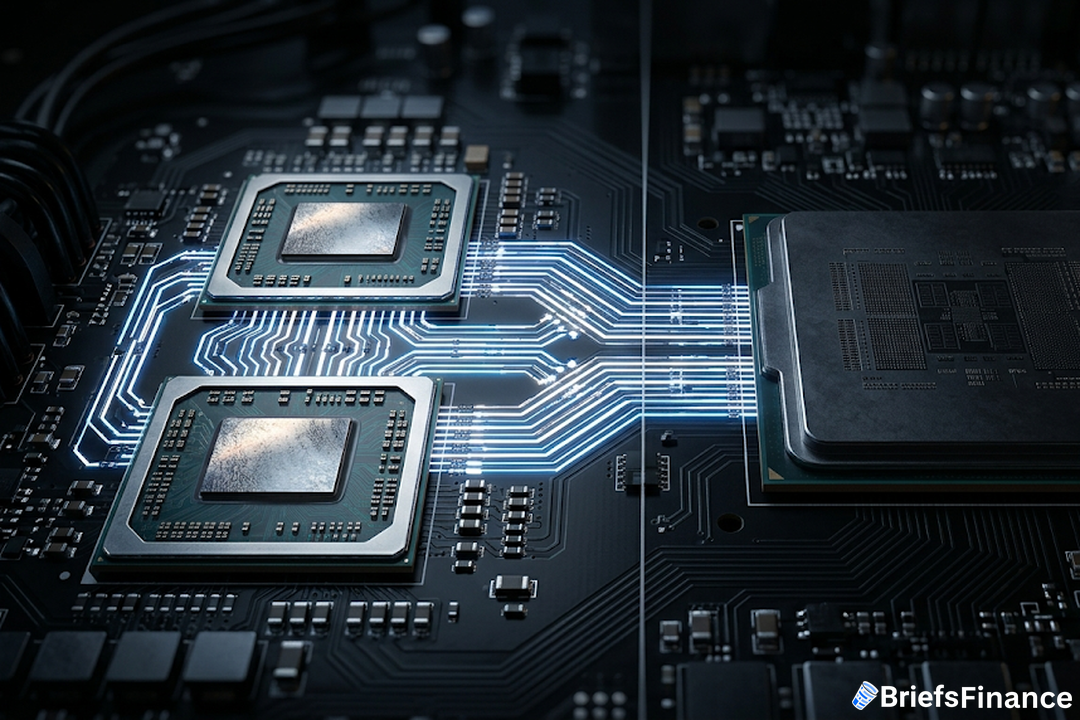
On July 23, CEO Lisa Su announced a partnership with Cerebras, a startup that makes a giant, wafer-sized AI chip. Together they are building a system called Helios. The big idea here is "disaggregated inference" - a fancy way of saying that instead of using the same chip for every part of an AI answer, you split the work across different hardware that is better suited for each step.

Think of it like this. When you ask an AI a question, the first step is understanding what you typed. Then the model has to generate a response.

AMD believes that these two phases are not alike, so they warrant separate types of hardware. Processing a prompt and generating tokens are not the same thing, so why treat them that way?

Su put a number on the claim. She said, "Helios can process up to 30% more inference tokens per dollar than Nvidia's Vera Rubin NVL72 rack." That is a direct comparison against the market leader. It is also the kind of stat that gets the attention of anyone running a data center on a budget.

Get the market news that matters in a five-minute read with Market Briefs, our free daily newsletter

Why the Industry Is Shifting Toward This Approach

This move is not happening in a vacuum.

AI companies have spent the last few years mostly focused on training models - teaching them on huge datasets. That phase is not over, but the focus is shifting toward inference, which is what happens when you actually use the model to generate answers. Every time you type a prompt into ChatGPT or any other AI tool, you are using inference. And as those tools get more popular, inference costs become a much bigger deal.

Investment bank UBS noticed this trend back in June. They wrote a note about the shift toward disaggregated inference, pointing out that Nvidia is already working on similar setups through its acquisition of hardware startup Groq. Amazon Web Services is also exploring the same idea, according to UBS.

The catch is that making different chips work together smoothly is hard. Disaggregated inference creates new challenges in getting all that hardware to talk to each other without bottlenecks or slowdowns. But the potential payoff - lower costs and better performance - is big enough that the industry is pushing forward anyway.

What This Means for Your Portfolio

AMD's Helios announcement is just one piece of a much larger puzzle.

The company already has a long list of big-name customers for its AI infrastructure. OpenAI, Meta, Microsoft, and Oracle all use AMD's chips. On July 22, one day before the Helios news, AMD announced a multibillion-dollar infrastructure partnership with Anthropic, the AI lab behind Claude.

That kind of demand is why AMD is betting big on a shift in how AI hardware works. If disaggregated inference really does deliver better performance for less money, it could put pressure on Nvidia's dominance. And when chip costs come down, the companies that buy those chips - the AI labs, the cloud providers, the tech giants - can spend more on other things or pass savings along to users.

For investors, the takeaway is not about picking a winner between AMD and Nvidia today. It is about watching how the industry evolves. If the approach Helios uses proves out, it could reshape who builds the next generation of AI infrastructure. That ripple could hit a lot of the stocks in your portfolio, whether you own chipmakers directly or hold funds that track the broader tech sector.

Join Market Briefs, our free daily newsletter, for a quick daily rundown of the markets
Disclosure

Recent News

1 2 3 72

Get Market Briefs delivered to your inbox every morning for free!

No fluff. No noise. No politics. Just finance news you can read in 5 minutes.

Blogs

September 10, 2026
US National Debt Hits $40 Trillion: Why the Economy Hasn't Collapsed Yet
  • The US national debt crossed $40 trillion in 2026 and is growing faster than the economy. The debt to GDP ratio now sits at 125%, the highest outside the pandemic and higher than World War II.
  • On September 9, 2026, Treasury Secretary Scott Bessent rolled out an emergency plan for the government to lend money to itself. Ray Dalio now says the dollar has roughly three years before real pain.
  • Empires rarely default. They debase. Since 1971, median household income grew about 8x while houses grew 17x and the S&P 500 grew 360x, so investors got richer while workers fell behind.
Read More
September 9, 2026
Your 401k Is Fueling the AI Bubble
  • About $10 trillion of 401k money sits in a $77 trillion stock market, mostly through target date funds and S&P 500 funds. Roughly 30% of every S&P 500 dollar lands in five AI-heavy tech stocks.
  • Four bubble signals run hotter today than before the 2000 crash: top-ten concentration, tech's share of the index, the Buffett Indicator, and how much of the market index funds own.
  • You only lock in an AI bubble loss if you sell. The 2022, 2020, 2008, and 2000 crashes were all buying windows for long-term investors, and the US-China AI race means government money could keep flowing in.
Read More
September 9, 2026
What Is Wealth Preservation? How To Protect Your Money From Anything
  • Wealth preservation is an investing strategy built around keeping the money you've already made instead of chasing growth.
  • It leans on assets that hold steady when markets fall - gold, Treasury bonds, and companies that keep earning through wars, crashes, and pandemics.
  • The tradeoff is real: you give up some upside, and the two key numbers to check are maximum drawdown and correlation to the market.
Read More
September 8, 2026
Why Is Everything So Expensive? Why Prices May Never Come Back Down
  • Official inflation is 3.4% and prices are up 32% since 2020, but rent (41%), gas (47%), car insurance (64%) and ground beef (79%) all outran the 28% median wage.
  • The Federal Reserve targets 2% inflation on purpose. Rising prices push extra dollars to investors and shrink the real cost of a $40 trillion national debt.
  • Investors who simply owned the S&P 500 gained about 150% over the same six years, and the Fed's September 16 decision will show whether it protects the dollar or the economy first.
Read More
September 7, 2026
The U.S. Housing Market Just Flipped: Renting a Home Now Beats Buying One
  • The US is in a buyer's market in 41 of the 50 largest metro areas, but prices sit near record highs and mortgage rates are close to 7%.
  • The same median house costs 27% more than it did in 2021 while the monthly payment costs 90% more, and incomes rose a little more than 10%.
  • A 2008-style crash is not showing up in the data, so the pressure is landing on buyers instead of prices.
Read More
September 4, 2026
An Interest Rate Hike in 2026? The Fed Just Broke Its Own Script
  • The Federal Reserve spent a year signaling cheaper money, and its new chairman just warned that an interest rate hike may be coming instead.
  • The Fed is stuck between high inflation and a weak job market, and fixing one makes the other worse.
  • Higher rates also reprice roughly a third of America's $40 trillion national debt this year, which is why Washington wants cuts so badly.
Read More
September 3, 2026
5 Passive Income Ideas That Pay You Whether You Work or Not
  • School teaches one formula: work, earn, spend. Stop working and the money stops, so the wheel never ends.
  • Five assets pay you without your labor - dividends, rent, interest, royalties, and the things you already own.
  • $80,000 a year of cash flow takes about $1 million invested at 8%, or roughly 20 years of $1,000 a month.
Read More
September 2, 2026
The Best Way to Invest 10k: Three Options To Transform 10K into 10 Million
  • Passive investing in stocks or real estate targets around 10% a year, and time in the market matters more than the price you get in at.
  • Active investing means putting your time in alongside your money, which raises the target to roughly 20% a year and raises the risk of losing it all.
  • Investing in yourself has no ceiling, because a new skill can create a new income that no market return can match.
Read More
September 1, 2026
The Tax Write Offs the Rich Are Using in 2026 While the IRS Shrinks
  • The 2026 tax brackets landed lower than they were headed, and the standard deduction jumped from a planned $8,350 to $16,100 for single filers.
  • New write offs for overtime, tips, seniors and car loan interest are live now, and most of them are written to expire in 2028.
  • About a third of IRS auditors have been fired, and four assets do most of the work for people who want income without a matching tax bill.
Read More
August 31, 2026
America Is Running Out of Debt Buyers. Treasury Bills Are the Government's Fix
  • The government took in about $5 trillion in taxes in 2025 and spent about $7 trillion, and the national debt is now over $40 trillion.
  • Investors, banks, and foreign countries are all lending less to the U.S., so starting September 9 the government plans to sell more short-term treasury bills and use that cash to buy back its long-term debt.
  • Government interest rates set the floor for your mortgage, your car loan, and your credit card, and short-term Treasury ETFs like SGOV are one way investors are playing it.
Read More
1 2 3 26
Share via
Copy link











