Free NewsletterPro Login

Warning: Undefined variable $stocks in /var/www/briefs.co/htdocs/wp-content/plugins/oxygen/component-framework/components/classes/code-block.class.php(133) : eval()'d code on line 448

Warning: foreach() argument must be of type array|object, null given in /var/www/briefs.co/htdocs/wp-content/plugins/oxygen/component-framework/components/classes/code-block.class.php(133) : eval()'d code on line 448

Warning: Undefined variable $funds in /var/www/briefs.co/htdocs/wp-content/plugins/oxygen/component-framework/components/classes/code-block.class.php(133) : eval()'d code on line 472

Warning: foreach() argument must be of type array|object, null given in /var/www/briefs.co/htdocs/wp-content/plugins/oxygen/component-framework/components/classes/code-block.class.php(133) : eval()'d code on line 472
/* the link was here */

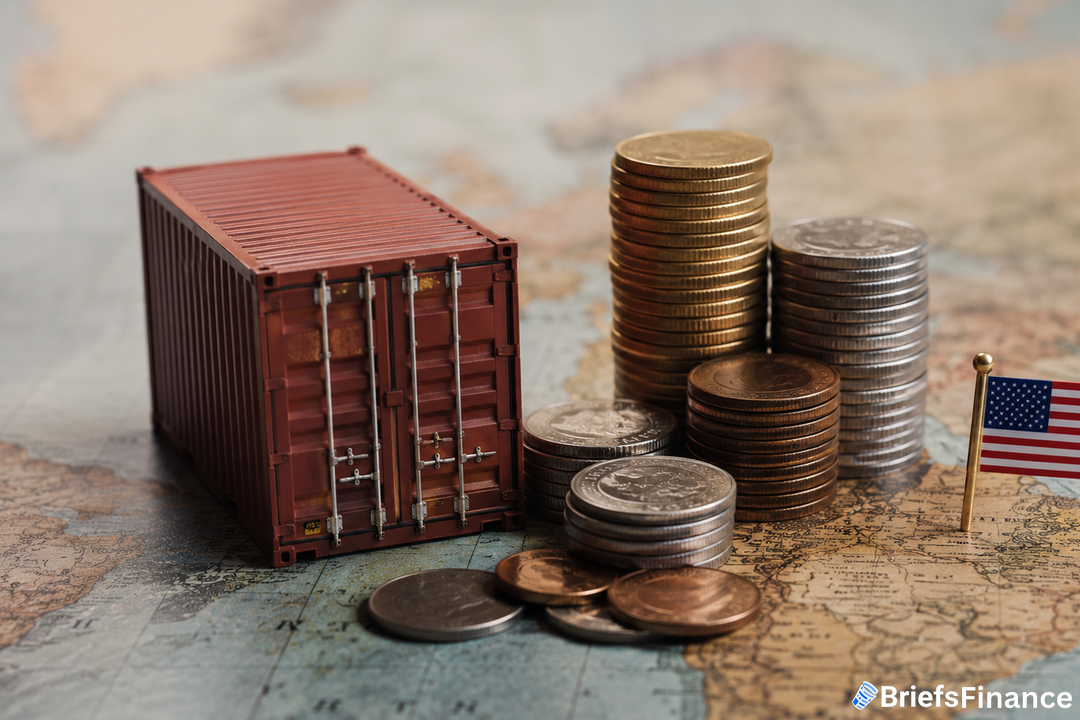
Canada Announces Retaliatory Tariffs on U.S. Goods

Published Aug 25, 2026
[tts_player]
Share:
Summary:
  • Canada is hitting back at President Trump's 50% duties on certain Canadian goods with new tariffs of its own on American products.
  • Trade Minister Dominic LeBlanc confirmed the plan to CNBC, with the formal announcement set for a media event at 11 a.m. ET on Tuesday, August 25, 2026.
  • LeBlanc said Canada still hopes for a deal that benefits both countries, but it is not waiting.

Canada Confirms Its Retaliation Plan

Canada is done waiting for Washington.

President Trump's 50% duties on certain Canadian goods came after trade negotiations between the two neighbors collapsed. Canada's answer is a new round of tariffs on U.S. products.

A tariff, or duty, is essentially a tax levied on goods as they pass across a border.

In trade terminology, this is known as a countermeasure, which is simply a formal term for a response. When one country taxes another's goods, the second country often answers with taxes of its own, and the cycle can keep going until someone changes course.

The timing matters too. An announcement at 11 a.m. ET falls during trading hours, so investors will have a chance to respond right away.

A Deal Is Still the Goal

LeBlanc made no effort to hide where Canada stands.

"Our preference was not to do that," he said. "Our preference was to find a deal that benefits both countries."

In other words, tariffs are a fallback, not a first choice. The outcome he wants is still a deal that works for both sides.

He still believes that deal is possible. But he also made clear that Canada is not going to sit around waiting for the U.S. to make the next move.

As trade tensions heat up, grab the free Always Be Buying E-Book and keep your wealth plan simple

"We still believe that's possible. But in the meantime, we're not waiting by the phone."

Trade officials use this kind of language all the time: keep talking, but keep the tariffs moving. It is how countries show they are serious without slamming the door.

What Tariffs Do to Prices and Profits

The bill for those tariffs always lands somewhere. A company can swallow the cost, hand it to customers, or squeeze it out of its own profits.

The same logic applies on both sides of the border. Canadian shoppers could see higher prices on U.S. goods, and American companies selling into Canada could feel the pressure in their sales.

Tariffs also travel through supply chains. A business that buys supplies from the other country faces a higher bill, and that extra cost can move down the line before anyone sees the final price.

The first product to feel the hit is rarely the last one.

At 50%, the American duties are not a small nudge. They are the kind of number that can change a company's math.

Uncertainty is a big deal for businesses too. When trade rules change quickly, companies may hold off on hiring, buying equipment, or expanding across the border until they know what the new rules will cost.

That kind of uncertainty is hard to put a number on. It is not just the tariffs themselves, but the question of where they stop.

The Stakes for Your Portfolio

The bigger question for investors is what this fight does to a trading relationship that affects a lot of businesses. The U.S. and Canada are major trading partners, and companies on both sides have built their operations around easy cross-border trade.

New tariffs add friction to that setup. Costs go up, profits get squeezed, and the uncertainty can ripple through stock prices.

Tuesday's announcement will show exactly what Canada's countermove looks like. The details will matter, but the direction is already clear: Canada is not backing down.

The effects will unfold over time, in prices and in the profits of companies you may already own. For investors, what matters is what comes after the announcement.

If the two sides calm down, this becomes a bump in the road. If they keep pushing, the costs will spread, and your portfolio can feel it.

The history of trade disputes shows that both sides often escalate before a resolution. Canada's move is a clear signal that it will defend its interests, but it has also left the door open for talks. The coming days will reveal whether the two governments can find common ground or whether this cycle of tariffs will continue to deepen.

Tariff news may bring uncertainty, so get the free Always Be Buying E-Book to stay steady and keep investing


Disclosure

Recent News

1 2 3 69

Get Market Briefs delivered to your inbox every morning for free!

No fluff. No noise. No politics. Just finance news you can read in 5 minutes.

Blogs

September 7, 2026
The U.S. Housing Market Just Flipped: Renting a Home Now Beats Buying One
  • The US is in a buyer's market in 41 of the 50 largest metro areas, but prices sit near record highs and mortgage rates are close to 7%.
  • The same median house costs 27% more than it did in 2021 while the monthly payment costs 90% more, and incomes rose a little more than 10%.
  • A 2008-style crash is not showing up in the data, so the pressure is landing on buyers instead of prices.
Read More
September 4, 2026
An Interest Rate Hike in 2026? The Fed Just Broke Its Own Script
  • The Federal Reserve spent a year signaling cheaper money, and its new chairman just warned that an interest rate hike may be coming instead.
  • The Fed is stuck between high inflation and a weak job market, and fixing one makes the other worse.
  • Higher rates also reprice roughly a third of America's $40 trillion national debt this year, which is why Washington wants cuts so badly.
Read More
September 3, 2026
5 Passive Income Ideas That Pay You Whether You Work or Not
  • School teaches one formula: work, earn, spend. Stop working and the money stops, so the wheel never ends.
  • Five assets pay you without your labor - dividends, rent, interest, royalties, and the things you already own.
  • $80,000 a year of cash flow takes about $1 million invested at 8%, or roughly 20 years of $1,000 a month.
Read More
September 2, 2026
The Best Way to Invest 10k: Three Options To Transform 10K into 10 Million
  • Passive investing in stocks or real estate targets around 10% a year, and time in the market matters more than the price you get in at.
  • Active investing means putting your time in alongside your money, which raises the target to roughly 20% a year and raises the risk of losing it all.
  • Investing in yourself has no ceiling, because a new skill can create a new income that no market return can match.
Read More
September 1, 2026
The Tax Write Offs the Rich Are Using in 2026 While the IRS Shrinks
  • The 2026 tax brackets landed lower than they were headed, and the standard deduction jumped from a planned $8,350 to $16,100 for single filers.
  • New write offs for overtime, tips, seniors and car loan interest are live now, and most of them are written to expire in 2028.
  • About a third of IRS auditors have been fired, and four assets do most of the work for people who want income without a matching tax bill.
Read More
August 31, 2026
America Is Running Out of Debt Buyers. Treasury Bills Are the Government's Fix
  • The government took in about $5 trillion in taxes in 2025 and spent about $7 trillion, and the national debt is now over $40 trillion.
  • Investors, banks, and foreign countries are all lending less to the U.S., so starting September 9 the government plans to sell more short-term treasury bills and use that cash to buy back its long-term debt.
  • Government interest rates set the floor for your mortgage, your car loan, and your credit card, and short-term Treasury ETFs like SGOV are one way investors are playing it.
Read More
August 23, 2026
How to Get the Most From Your Guideline 401k
  • Guideline is a company that provides low-cost 401k plans, popular with small businesses and their employees.
  • A "Guideline 401k" follows the same core rules as any 401k: tax-advantaged growth, contribution limits, and often an employer match.
  • The biggest results come from capturing the full match, choosing low-cost funds, and picking Roth or traditional to fit your situation.
Read More
August 23, 2026
Principal 401k: What to Know About Your Plan
  • Principal is one of many companies that manage workplace 401k plans, so a "Principal 401k" is simply a 401k where Principal is the provider.
  • The rules of a 401k are the same no matter who runs it: pre-tax or Roth contributions, tax-advantaged growth, and often an employer match.
  • The biggest wins come from grabbing the full match, picking low-cost funds, and knowing whether Roth or traditional fits you.
Read More
August 23, 2026
What a Tariff Dividend Means for Your Money
  • A "tariff dividend" is the idea of taking money the government collects from tariffs and paying some of it back to citizens.
  • To judge the idea, you first need to know what a tariff is: a tax on imported goods, usually paid by the companies bringing them in.
  • Tariffs ripple through prices, businesses, and your investments, so the smart move is understanding those ripples, not just the headline.
Read More
August 23, 2026
No Tax on Overtime: How Overtime Pay Is Taxed
  • "No tax on overtime" refers to a tax break that lets certain workers deduct some overtime pay, lowering the income they get taxed on.
  • A deduction does not mean overtime is truly tax-free. It means part of that pay is subtracted before your tax is figured.
  • The bigger money lesson: how you earn money changes how it is taxed, and investors often get the friendliest treatment of all.
Read More
1 2 3 26
Share via
Copy link