Free NewsletterPro Login

Warning: Undefined variable $stocks in /var/www/briefs.co/htdocs/wp-content/plugins/oxygen/component-framework/components/classes/code-block.class.php(133) : eval()'d code on line 448

Warning: foreach() argument must be of type array|object, null given in /var/www/briefs.co/htdocs/wp-content/plugins/oxygen/component-framework/components/classes/code-block.class.php(133) : eval()'d code on line 448

Warning: Undefined variable $funds in /var/www/briefs.co/htdocs/wp-content/plugins/oxygen/component-framework/components/classes/code-block.class.php(133) : eval()'d code on line 472

Warning: foreach() argument must be of type array|object, null given in /var/www/briefs.co/htdocs/wp-content/plugins/oxygen/component-framework/components/classes/code-block.class.php(133) : eval()'d code on line 472
/* the link was here */
×
Free investor livestream — Nov 17

How To Use ChatGPT & Claude To Research Stocks Like A Pro

01
The prompt we use to break down any stock
02
How to fact-check what AI tells you
03
How to compare two stocks in minutes

Gulf's Richest States Push Ahead With Big AI Data-Center Plans Despite Attacks

Published Sep 4, 2026
Share:
Summary:
  • The UAE and Saudi Arabia are charging forward with huge AI infrastructure builds even as regional data centers become targets amid the US-Iran conflict.
  • Abu Dhabi's campus aims to add five gigawatts of compute, while Saudi-backed Humain is pursuing over six gigawatts and is seeking an initial $2.5 billion for sites across the country.
  • Strikes in March and July hit AWS facilities in Bahrain and the UAE, raising costs and risk for heavyweight partners like OpenAI, Microsoft and Nvidia.

Projects and scale under way

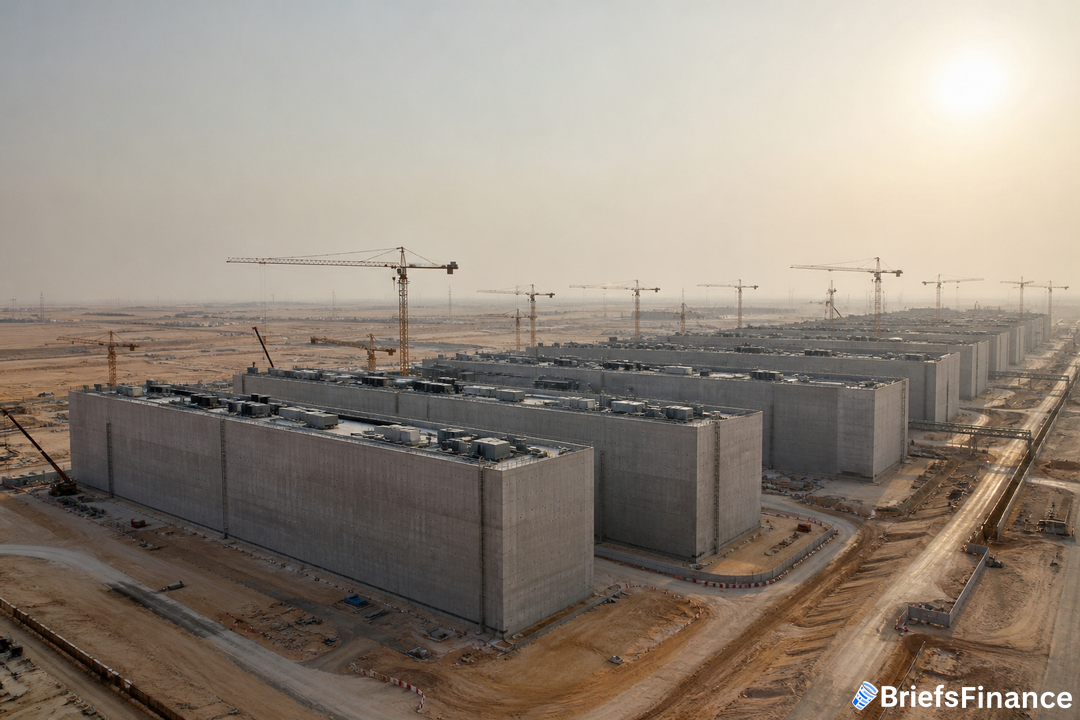
Gulf leaders want growth that is not tied to oil, and AI compute is their new calling card. In the UAE, government-linked firms are pressing ahead on a massive Abu Dhabi AI campus designed to bring online five gigawatts of computing power, according to people familiar with the effort. Khazna, the G42-backed builder in charge of the site's infrastructure, said it expects to bring the first 200 megawatts online in the fourth quarter. "We have not seen any slowdown in customer demand or confidence as a result of the recent regional events," the company said.

In Saudi Arabia, Public Investment Fund-backed Humain is looking to tap global and local backers for an initial $2.5 billion to build data centers across the kingdom, people familiar with the plan said this week. The company is proceeding with a buildout topping six gigawatts in Saudi Arabia and says its schedule remains intact despite the war.

These headline projects lean on a familiar pitch to AI developers: lots of land and ample energy. They also depend on heavyweight collaborators such as OpenAI, Microsoft Corp. and Nvidia Corp., who now have to weigh higher operating risk and cost as the conflict grinds on.

Attacks, damage and security costs

The cloud buildout is happening as infrastructure takes fire. In July, satellite imagery indicated two Amazon.com Inc. facilities in Bahrain were damaged after Iran said it fired missiles at the sites. A spokesperson for the Islamic Revolutionary Guard Corps told the state-backed Tasnim agency the strikes targeted "a major information-processing asset of the enemy." In March, drones struck three AWS facilities in the United Arab Emirates and Bahrain, and the company has conceded that service across the region has deteriorated.

Major US partners tied to UAE and Saudi builds have mostly kept quiet since the war began. Recently, Amazon said that by 2028 it intends to provide up to 50 megawatts within Saudi Arabia's first AI Zone as part of a wider partnership, and Microsoft said its Saudi Arabia East cloud region will open to customers in November 2026. OpenAI said it is "continuing to make good progress on the infrastructure and adoption priorities" in the UAE.

Hardening sites can lower risk but adds cost. Integrated Security Systems estimates that bolstering physical security features such as perimeter walls and server protection would lift build costs by about 5 to 7 percent. "There is now a higher perception of physical risk as data centers are no longer just viewed as IT assets, they are regarded increasingly as critical infrastructure that could be targeted during a threat," said ISS Chief Executive Officer Jane Mason, whose company offers ballistic and blast-proof panels.

Recent US and Iranian strikes have underscored the ongoing danger. As Winston Ma, a New York University professor and AI investor, put it, "Most likely, the hyperscalers are going to hedge their global map of data center connectivity." He added, "Gulf funds can build the data centers and supply the power, but without long-term commitments from Western hyperscalers and clear US regulatory alignment, those mega-projects risk becoming high-tech real estate with empty servers."

Understanding what moved a market beats knowing that it moved. Get the free Market Briefs daily newsletter and follow the drivers.

Partners, politics and investor views

Washington's rules are shaping what gear can be brought to the Gulf. This year, the Trump administration loosened certain export limits on the UAE, letting approved firms - including G42, the main force behind the Abu Dhabi campus - buy advanced AI chips without seeking US approval each time.

OpenAI last year said one gigawatt at the Abu Dhabi campus would house Stargate UAE, the first overseas node of its flagship infrastructure joint venture. Since then, OpenAI has stepped back from other international Stargate locations and dropped the Stargate label from newer efforts. Sources say the UAE-US AI Campus no longer uses the Stargate branding for phase one of the project.

Oil money is powering the boom. July saw Abu Dhabi's MGX secure $49 billion, forming one of the largest AI-focused funds, while state-backed investors around the region continue to be key backers of OpenAI, Anthropic and SpaceX. A large private equity firm said it expects Gulf data-center demand to keep climbing and is hunting for assets to buy now and sell at higher prices later. According to Jacopo Pichelli, a managing director at FTI Capital Advisors and an adviser to operators in the region, local investors remain unfazed, while foreign investors are split - some are proceeding much as before, others prefer to wait and see.

Assad Noori, Head of Data Centres, Work Dynamics EMEA at JLL, said the binding constraint is more regulatory than commercial. The key issue, he said, is US export control over advanced chips, which determines what can be installed and by whom.

Officials for the UAE and Saudi governments did not reply to requests for comment. Microsoft offered no comment. Amazon, meanwhile, offered no additional comment beyond directing users to its service health page, where notices tell customers to steer clear of portions of its network that the attacks have disrupted.

What this means for your portfolio

The Gulf is pouring money into compute, even as missiles and drones raise the stakes. Builders like Khazna and Humain are scaling capacity, while big US tech names and chip rules will decide what actually runs on those racks. With some investors shopping for deals and others sitting tight, expect a mix of opportunity and caution - and for risk to be priced in, not waved away.

Disclosure

Recent News

1 2 3 … 121

Get Market Briefs delivered to your inbox every morning for free!

No fluff. No noise. No politics. Just finance news you can read in 5 minutes.

Blogs

November 3, 2026
How to Budget Every Payday: 5 Moves So You Never Worry About Money
  • A median earner could make about $4.7 million over a career, yet most retire with closer to $13,000 in the bank because of a keeping problem, not an income problem.
  • Audit your money, save $2,000, pay off credit card debt, then automate a 75/15/10 split across three bank accounts.
  • Earn more only after your system is in place, then protect what you build with an accountant, attorneys, the right insurance, and an estate plan.
Read More
November 3, 2026
How to Invest in Stocks: 5 Things to Do Before You Invest Your First Dollar
  • Paying off credit card debt at around 22% interest beats the stock market's roughly 10% average, and even Warren Buffett's 19%.
  • Save $2,000 in a separate emergency fund, learn to research with AI, and decide whether you're a growth, income, or wealth preservation investor.
  • Write down a plan for buying during market crashes, which have happened 25 times in the last 100 years.
Read More
November 3, 2026
Best ETFs to Buy: 5 Three-ETF Portfolios for Every Investing Goal
  • An ETF is a basket of stocks, so one purchase spreads your money across many companies instead of riding on just one.
  • Jaspreet Singh laid out five portfolios of three ETFs each, built for kids, cash flow, growth, slow and steady growth, and protection from a weaker dollar.
  • Based on 10-year average returns, $500 a month could grow to between about $660,000 and $3.1 million over 30 years, though past returns never guarantee future ones.
Read More
November 3, 2026
Best Investments of a Generation: 5 Market Shifts Backed by Your Tax Dollars
  • Private companies are about to spend $1 trillion a year on AI, and the Trump administration is putting tax dollars behind the same industries.
  • The five shifts are AI and its supply chain, robotics, rare earths, energy, and defense.
  • Each comes with real risk, from an AI bubble to wars ending or a new Congress, so these are ideas to research, not sure things.
Read More
November 3, 2026
How to Get Ahead Financially: 10 Moves to Make While Everyone Else Falls Behind
  • Learning a high-income AI skill, or building AI tools for tradespeople, can raise your earning power in a tough job market.
  • Higher interest rates, the 2025 tax cuts, Trump accounts, and stacked cash back can put more money back in your pocket.
  • Following where government money is moving, keeping cash ready for market crashes, and investing in your own education can speed up your wealth.
Read More
November 3, 2026
National Debt at $40 Trillion: Why Inflation Is the Hidden Tax, and Who Profits From It
  • Time magazine asked President Trump how he'd tackle the $40 trillion national debt, and he suggested inflation could help pay it off, a cost that lands on everyday Americans.
  • From 1971 to 2025, cars, houses, and college outpaced both inflation and incomes, while the S&P 500 grew more than 33,000% with dividends reinvested.
  • The U.S. can default, inflate, or outgrow its debt, and history shows each path rewards different assets.
Read More
November 3, 2026
FOMC Meeting: Why the Fed Is Getting Nervous, and Why AI Stocks Feel It
  • At its latest meeting, the Fed held rates steady but warned it may raise them again, because inflation is running near 3.5% against a 2% target.
  • Oil prices, tariffs, AI's hunger for energy, and government spending are all pushing prices higher, and gold, silver, and bitcoin fell on the Fed's news.
  • Chinese AI stocks are down about 40% in a few months and Google fell more than 10% in a day, raising fears that higher rates could pop an AI bubble.
Read More
November 3, 2026
Midterm Elections: Where the Money Could Move if Republicans or Democrats Win
  • The U.S. government spent about $7.5 trillion last year, and the midterm elections could change which industries get more of that money.
  • A Republican win could favor manufacturing, fossil fuels, banks, and defense.
  • A Democratic win could favor healthcare, weight-loss drugs, clean energy, and infrastructure.
Read More
November 3, 2026
Brazil Stock Market Crash: Why Lula's Win Matters to U.S. Investors
  • Brazil's stock market fell more than 20% in a few days, and its currency dropped 8%, after Lula won a presidential election investors expected him to lose.
  • The shock reaches U.S. investors through coffee and beef prices, the BRICS push away from the dollar, and a market that had become an investor favorite.
  • The last time Lula first won, in 2002, Brazil's stock market fell more than 20% and then grew 12x by 2008, though nobody knows if that will repeat.
Read More
November 2, 2026
Credit Utilization: How Paying Down Cards Can Help Your Score
  • Credit utilization is your card balances divided by your credit limits, checked overall and card by card.
  • Lower is generally better, and Experian says the effect becomes more noticeable around 30%.
  • Paying down balances and keeping new charges off your cards are the main ways to lower it.
Read More
1 2 3 … 32
Share via
Copy link










