Free NewsletterPro Login

Warning: Undefined variable $stocks in /var/www/briefs.co/htdocs/wp-content/plugins/oxygen/component-framework/components/classes/code-block.class.php(133) : eval()'d code on line 448

Warning: foreach() argument must be of type array|object, null given in /var/www/briefs.co/htdocs/wp-content/plugins/oxygen/component-framework/components/classes/code-block.class.php(133) : eval()'d code on line 448

Warning: Undefined variable $funds in /var/www/briefs.co/htdocs/wp-content/plugins/oxygen/component-framework/components/classes/code-block.class.php(133) : eval()'d code on line 472

Warning: foreach() argument must be of type array|object, null given in /var/www/briefs.co/htdocs/wp-content/plugins/oxygen/component-framework/components/classes/code-block.class.php(133) : eval()'d code on line 472
/* the link was here */
×
Free investor livestream — Nov 17

How To Use ChatGPT & Claude To Research Stocks Like A Pro

01
The prompt we use to break down any stock
02
How to fact-check what AI tells you
03
How to compare two stocks in minutes

Rain-Soaked Brazil Pushes Arabica Coffee Prices Upward

Published Aug 23, 2026
Share:
Summary:
  • Heavy rains in Brazil's Cerrado Mineiro region have damaged the arabica crop, reducing the supply of high-quality beans.
  • Coffee futures have climbed about 35% since June, and top Brazilian coffee is trading at a premium.
  • The upcoming harvest may produce a surplus, but quality issues could widen the gap between premium and everyday coffee.

Your morning cup of coffee is about to get more complicated.

The problem starts in Brazil, which grows about 45% of the world's arabica beans - the mild, kind that premium roasters love. And this year, the rain just will not stop.

Too Much Rain in the Wrong Place

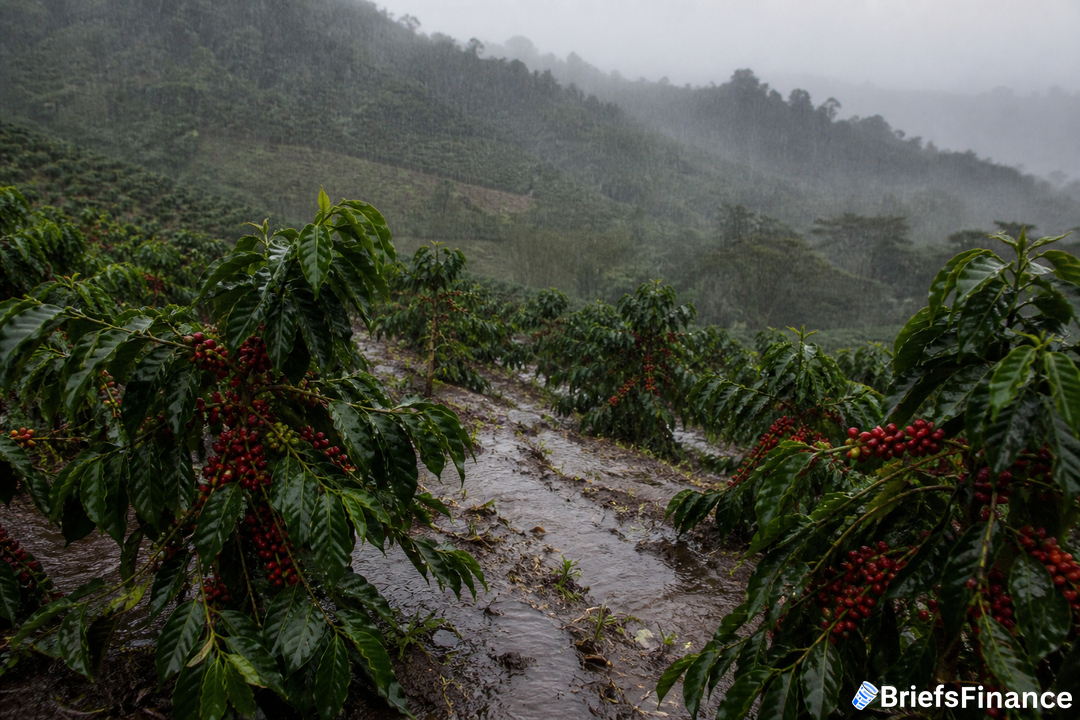
Brazil's Cerrado Mineiro region, located some 600 kilometers north of São Paulo, experienced heavy downpours during June and July. Rainfall in coffee areas ran 250% to 500% above normal, and some spots saw eight times their usual amount.

That sounds like good news for thirsty plants. It is not.

Coffee cherries that get knocked off the trees by heavy rain end up sitting on waterlogged soil. Some stayed wet for days. Beans that linger in that dampness start to ferment and develop defects, which ruins the delicate flavors that make fine arabica worth paying for.

"The vast majority of the fastest beans end up developing quality problems, resulting in coffee with a higher grade of fermentation, which significantly affects the beverage," said Simão de Lima, head of a coffee cooperative.

Rates, prices and policy all end up in your budget eventually. Get the free Market Briefs daily newsletter and see it coming.

In a normal year, about 5% to 7% of the cherry crop falls to the ground. Lima expects losses around 20% this year. And an extra round of rain in July hit coffee that was already drying, forcing producers to start the drying process all over again.

"You have coffee that's already drying on the ground, then more rain falls on that coffee and you have to start staging all over again," Lima said.

What This Means for Prices

The damage is not just about quantity. It is about quality. Exchange-grade coffee - the stuff that can be traded on futures markets - has to pass professional tasters. It must be sound, not stale or unwashed, with good roasting characteristics and the right size and color.

Normally, about 30% to 35% of Brazil's coffee qualifies for those exchange standards. Lima estimates that this year, only 10% to 15% will make the cut.

That scarcity is showing up in the physical market, where top Brazilian coffee is fetching up to 15 cents per pound more than the New York futures price. Stockpiles in U.S. and European warehouses are shrinking, with global inventories near their lowest levels since the turn of the century.

The catch: even buyers who usually blend different coffee sources are competing for a smaller pool of premium beans. Companies like Starbucks and Lavazza have options - they can raise prices for their premium lines or mix in more lower-grade coffee. But there is only so much high-quality arabica to go around.

What It Means for Your Wallet

The upcoming harvest is expected to produce a bumper crop. That sounds reassuring, but it does not solve the quality problem.

Cristina Scoccella points out that some of the price increase is driven by market dynamics, not just quality issues. She said that well-funded farmers are not desperate to sell, which pushes prices higher.

Brazil's dominant position in the global arabica market means that even a modest drop in high-quality output can shift prices worldwide. When the supply of premium beans shrinks, roasters who need them for top-shelf offerings must compete aggressively, driving up costs for the most desirable lots.

For you, the buyer, this plays out in two ways. Premium coffee could get pricier as roasters pay up for scarce high-grade beans.

The good news is that the market is working. Higher prices encourage farmers to protect their crops and invest in better drying equipment. But for now, if you have a favorite specialty roast, it might be worth locking in a bag or two before the next harvest proves what this season's rain really cost.

The best financial decisions come from understanding the whole picture. Join Market Briefs free and get the full brief each morning.

Disclosure

Recent News

1 2 3 … 111

Get Market Briefs delivered to your inbox every morning for free!

No fluff. No noise. No politics. Just finance news you can read in 5 minutes.

Blogs

October 23, 2026
Are We in a Recession? 5 Threats to the Economy and Where the Money Is Moving
  • The S&P 500 is up about 13% this year, but without AI it's in a bear market, with nearly 40% of its companies down more than 20% for four months or longer.
  • Jackson, Briefs Finance's head of investing research, sees five threats: rising interest rates, sticky inflation, an economy propped up by AI, a struggling UK, and high oil prices.
  • The opportunities he's watching mostly sit outside the dollar: rising economies like Brazil and Indonesia, US-backed emerging market bonds paying 7% to 9%, and the shifts that fear creates.
Read More
October 16, 2026
How Boring Math Makes You Rich: The Briefs Money Spreadsheet, Explained
  • Briefs Money shows you what to do with every paycheck, and in what order: how much to spend, save, and invest, when to build an emergency fund, and which debt to pay off first.
  • The Climb to Wealth course walks you through the system step by step, and the Personal Finance Spreadsheet is where you track your own numbers.
  • Investing is one piece of building wealth. The system that gets money to your investments, and keeps it there, decides the outcome.
Read More
October 16, 2026
Common Investing Mistakes: Why a Stock Grade Is One Tool, Not the Whole Toolkit
  • The Briefs Score shows growth, income, and wealth preservation investors how well a stock fits their goal, with a separate letter grade for each one.
  • The most common mistake is treating the letter as an instruction. An A tells you a stock scores well for one goal, not that you should buy today.
  • Research works best as one input in a process you own. The grade shows how a stock stacks up. You supply the goal, the timeline, and the rules for being wrong.
Read More
October 16, 2026
How to Read a Company's Numbers Without a Finance Degree (Using Briefs Terminal)
  • Briefs Terminal lets you size up any public company in about ten minutes: what the stock costs, what it earns, how fast sales are growing, and what it pays you, all on one page.
  • It lines those numbers up against the company's closest competitors for you, so you can tell if a number is impressive or just average.
  • Below that are the income statement, balance sheet, and cash flow statement from the company's SEC filings, the latest news, and transcripts of its earnings calls.
Read More
October 16, 2026
What Type of Investor Am I? The Three Investor Archetypes, Explained
  • Briefs sorts its stock grades and monthly reports by three investor goals: growth, income, and wealth preservation. Pick yours and you know which report and which grade to read first.
  • Growth investors want stocks that beat the S&P 500. Income investors want to get paid in cash. Wealth preservation investors want stocks that hold up when the market drops.
  • The same stock can score an A- for one goal and a D- for another, so picking your goal comes before picking any stock.
Read More
October 16, 2026
How to Build a Stock Watchlist That Isn't Just Stocks You Heard About
  • A watchlist on Briefs Terminal lets you group stocks by the idea you're tracking and follow each one's price, one-day move, and 52-week high and low in one place.
  • Each list has its own name and description, so you always know why a stock is on it, and you can make as many lists as you have ideas.
  • The monthly growth, income, and wealth preservation reports under the Briefs Research tab hand you new themes to track that you didn't hear about online.
Read More
October 16, 2026
How to Choose an ETF That Matches Your Idea (Using the ETF Planning Tool)
  • The ETF planning tool takes an idea like "I want to invest in fast food companies," asks what you mean, and finds the ETFs that match, with the reasons, the holdings, and the sources.
  • Build a Plan then shows what your money could grow to in those ETFs over the years you choose, with conservative, expected, and optimistic estimates next to the S&P 500.
  • It gets you from an idea to an actual plan without researching dozens of companies one at a time.
Read More
October 16, 2026
Is This Stock a Good Buy? How to Use the Briefs Score to Tell If a Stock Fits the Way You Invest
  • The Briefs Score shows growth, income, and wealth preservation investors how well a stock fits their goal, with a separate letter grade for each one.
  • One stock can score very differently for each. Nvidia showed an A- for growth and a D- for income, because it grows fast and pays almost no dividend.
  • Seven sub scores under each grade show what earned the letter, so you can see exactly where a stock is strong or weak for your goal.
Read More
October 16, 2026
How to Tell an Asset From a Liability: The One Question to Ask Before You Buy Anything
  • The typical American household earned more in 2025 than in any year on record, yet only 30% of Americans say they could pay a surprise $1,000 bill from savings, so the problem isn't income but what the income gets spent on.
  • An asset puts money in your pocket and a liability takes money out, and the wealthy buy assets first, then let the assets pay for the fun stuff.
  • Before you buy anything, ask one question: does this put money in my pocket, or take money out of my pocket? Then you need a plan for the money you keep.
Read More
October 16, 2026
How to Build Your First $2,000 Emergency Fund and Wipe Out Every Debt Over 10%
  • Your first money goal isn't investing, it's $2,000 in its own account named Do Not Touch, built by moving 10% of every paycheck into it automatically.
  • More than a third of American adults couldn't cover a $400 surprise bill with cash or savings, according to the Federal Reserve, and that's how one bad day turns into years of credit card payments.
  • Once the $2,000 is there, attack every debt charging more than 10% interest, highest rate first, because you can't out-invest a 22% credit card so paying it off is the investment.
Read More
1 2 3 … 29
Share via
Copy link










